

Mr. Jonathan Kaufman

14/03/2023 (Tuesday) 15:00-16:00 E21B-G035 The Last Kings of Shanghai: How Two Rival Jewish Dynasties Ignited the Rise of China Abstract: Shanghai, 1936. The Cathay Hotel, located on the city's famous waterfront, is one of the most glamorous in the world. Built by Victor Sassoon--billionaire playboy and scion of the Sassoon dynasty--the hotel


Prof. Xiaoping Wu & Prof. Richard Fitzgerald

09/03/2023 (Thursday) 13:00-14:00 E21B-G002 Internet memes and health communication in the time of COVID-19 Abstract: This study examines official health communication through internet memes during the COVID 19 through drawing upon a case study in Shenzhen, China. Due to the worst outbreak in two years, Shenzhen, the southern tech hub and one

Prof. Dongjing Kang

06/03/2023 (Monday) 13:00-14:00 E21B-G035 Taming the Barbarian Empress: Post-alteric Imaginary of Gender Egalitarianism and Pan-Chinese Nationalism in the Legend of Xiao Chuo Abstract: Representations of ethnic minority women often symbolized China’s efforts in nation- building. This study uses insights from the post-alteric frame to analyze the images of the Khitan empress Xiao

Prof. Mike YAO

02/03/2023 (Thursday) 13:00-14:00 E21B-G002 From Computer-mediated Communication to AI-moderated Communication—prospects and limits of media and human communication research Abstract: The advent of artificial intelligence (AI) has dramatically impacted the way we communicate and how we understand communication. With the increasing prevalence of AI-mediated communication, researchers of human communication must take into consideration

Prof. Richard Fitzgerald

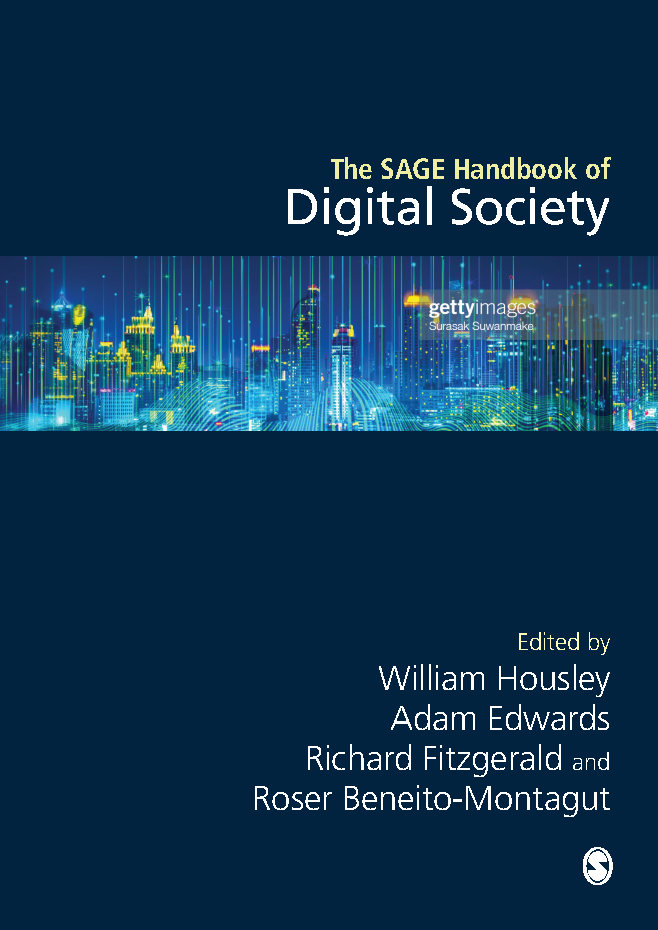
09/02/2023 (Thursday) 13:00-14:00 E21B-G002 The Emerging Contours of Digital Society: Remastering, Reconsideration, Reorientation and New Socio-Digital Domains Abstract This talk is based on a recently published book, The Sage Handbook of Digital Society (2023), which brings together cutting-edge social scientific research and theoretical insight into the emerging contours of Digital Society. Moving

Prof. Steve Jones

30/11/2022 (Wednesday) 11:00-12:00 E21B-G002 Social Robots and Research Ethics Abstract: It is already clear that data is being collected from humans with and through computers and other devices. Will the rapid dissemination of sensors, microphones, cameras, and other “Internet of Things” (IoT) devices usher in an age of ubiquitous data collection? I

Prof. Wei SHI

24/11/2022 (Thursday) 13:00-14:00 E21B-G002 Rethinking Chinese Popular Feminism Through Sisters Who Make Waves Abstract: The reality TV sensation Sisters Who Make Waves has recently garnered public attention in China, receiving many critical comments and sparking debates about middle-aged women. This talk focuses on the role of tears in configuring Chinese popular feminism

Prof. Hua ZHENG

10/11/2022 (Thursday) 13:00-14:00 E21B-G002 Theoretical Origin and Application of Strategic Communication in U.S. Diplomacy Abstract: Strategic communication has attracted much attention in political and academic circles because of its application to politics, economy, military and diplomacy. By tracing the development of strategic communication and exploring core concepts advocated by Edward Bernays, the

Prof. Barui K. WARUWU

28/10/2022 (Friday) 13:00-14:00 E21B-G002 The stories that tell us: An ethnographic approach to understanding mediated storytelling practices for family intimacy during migration Abstract: Within a family, narratives help define the relationship by allowing each member to articulate their relational needs, desires, and expectation. For migrant families, the need to craft and share

Prof. Jing MENG

20/10/2022 (Thursday) 13:00-14:00 E21B-G002 Indexicality and authenticity in digital images Abstract: Huawei’s smartphone P30 Pro, with a pre-installed algorithmic program, can automatically recognize and enhance images of the moon when taking photos. However, people feel that the AI-enhanced moon photo is ‘too real’ to be identified as real since it looks like